
Third Annual Meeting of the CGI-Clinics Project

We met in Thessaloniki, Greece, on 26–28 November 2025 for the third Annual Meeting of the CGI-Clinics project, now entering its fourth year. The consortium gathered to share updates and achievements, offering an excellent opportunity to celebrate progress and refocus on the work ahead. Partners who could not attend in person joined remotely, following the presentations online and taking part in live Q&A sessions.
For the first time at an in-person meeting, we heard several updates from our clinical partners on their usage of the CGI tool, reflecting on its efficacy and potential areas for improvement moving forward. Many thanks to all our clinical partners: Althaia, Institut Català d’Oncologia, Junta de Andalucia, Centre Léon Bérard, Fundació Institut d’investigació biomèdica de Girona Doctor Josep Trueta, Gustave Roussy, Uniklinik Koln, Uniklinik RWTH Aachen, University of Manchester, and Vall d’Hebron Institute of Oncology.
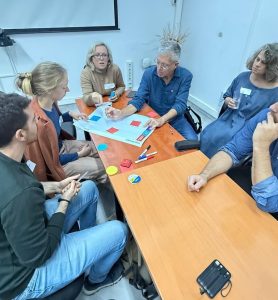
Group discussions during the values messaging workshop
Two specialised workshops were held on day one of the meeting. The first workshop, ‘Communication skills for clinicians’, facilitated by Anna Nisyraiou and Maria Vasilopoulou from CERTH, was designed to help equip consortium members with the skills needed to navigate potentially difficult conversations with patients when working in genomic medicine.
The second workshop, facilitated by Mercè Guerra and Sara Ramió from Alira Health, aimed to help develop value messaging to demonstrate the impact of the CGI tool.The latter aimed to help develop value messaging to demonstrate the impact of the CGI tool.
We also heard from Mata Laidou andTonia Kouroutzidou (CERTH) who delivered a talk focusing on the interpretation and clinical implications of variants of uncertain significance (VUS) in hematologic malignancies. This topic is critical at this stage of CGI-Clinics as we continue refining the biological impact of cancer mutations and ensuring consistent, evidence-based decision-making across centres. “Addressing VUS is essential for improving patient stratification and reducing ambiguity in clinical reports,” says Mata.
Santi Demajo (IRB Barcelona) provided a summary of the development and current status of the new CGI tool, alongside a detailed evaluation of its performance. He explained the various analyses conducted, such as comparing the tool’s classification against established knowledge bases like ClinVar and OncoKB, and analysing the Variants of Unknown Significance (VUS) reclassified. This is important as it substantiates the tool’s clinical utility and readiness for deployment.
Project Coordinator, Núria López-Bigas, began day two with a reminder to the consortium of the overarching aims of the project, emphasising that we are aiming for “a transformative project for the implementation of precision medicine in oncology”.
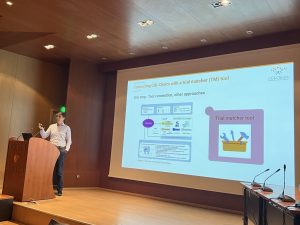
Pierre Saintigny
Pierre Saintigny (CLB) presented on his institute’s advancements on (1) the connection of CGI-Clinics with Electronic Health Records as an important proof of concept for interoperability feasibility, (2) the connection of CGI-Clinics with a trial matcher tool, since it is a key target objective of the project to ultimately improve the therapeutic orientation rate of patients, and (3) the first call of the initative CGI-500genomes, where CNAG contributes by sequencing 500 WES/WGS of cohorts from scientific and medical interest and the data will be shared with the research and clinical communities
The second day ended with a talk from Mercè Guerra and Sara Ramió focused on the performance activities being planned to meet regulatory requirements: an analytical performance study and a clinical performance study. These studies are needed to comply with the current EU regulations and to show that the CGI is a reliable and accurate tool. The analytical performance study will check that the tool works consistently from the technical point of view, while the clinical performance study will confirm that the tool gives accurate results when used in the clinical setting.
We are grateful to have been joined by several guest speakers during the meeting. Alona Sosinsky and Nadezda Volkova (Genomics England) shared highly valuable insights on integrating whole genome sequencing into clinical practice for cancer patients, and their use of the CGI tool. We also heard from Panagiotis Baliakas (Clinical Genomics Uppsala) who explored the milestones and challenges associated with germline investigation of hereditary hematological malignancies, emphasising that there is still much more to discover and so continued collaboration is essential.
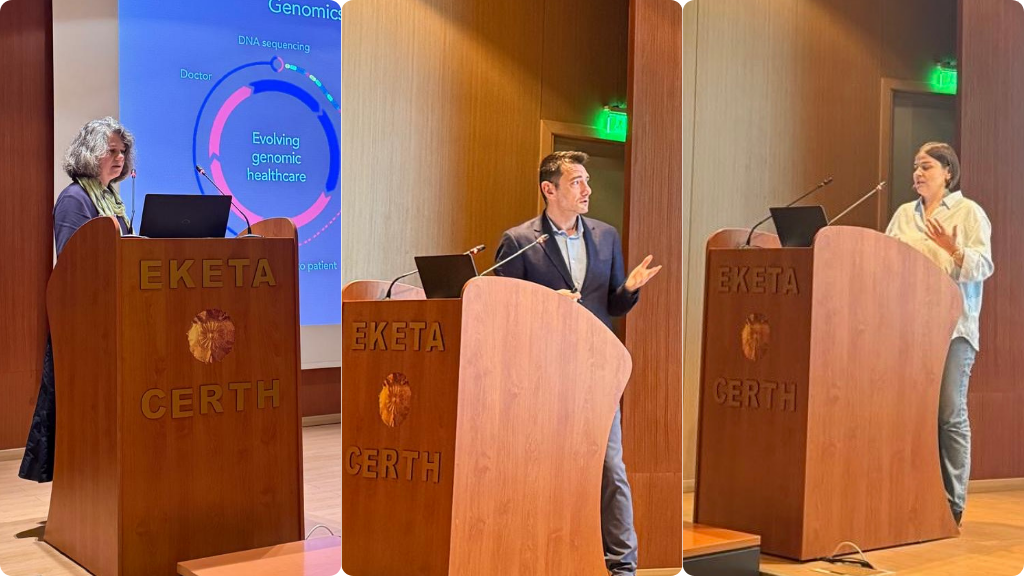
Alona Sosinsky, Panagiotis Baliakas and Nadezda Volkova
We heard updates on a first prototype of EduCGI from Vanesa Abon (FCAECC), Maria Escurriola and Joan Enric Ramis (IRB Barcelona). EduCGI is a patient-centred chatbot designed to translate complex cancer genomic information into clear, accessible language. Its integration into the CGI-Clinics framework is especially important at this stage, as it directly addresses the persistent gap between highly technical genomic data and the practical information patients need to understand their results. EduCGI represents the final, essential step in ensuring that cancer genomic insights are not only generated and interpreted, but ultimately delivered in a meaningful, supportive way to the person who needs them most: the patient.
Rachel Warden (European Association for Cancer Research) gave updates on this past year’s communication and dissemination activities, looking ahead to the launch of the openly accessible CGI tool in the beginning of 2026 and highlighting the importance of a community-led approach to disseminating news of the project to a wider audience.
Mireia Monras (VHIO) updated us on the progress of virtual molecular tumour boards, reflecting on lessons learned from their implementation so far. The aims of these boards are to provide expert opinion on individual patient cases, comprised of an online panel of experts in areas including genomics, pathology, oncology, biology and patient advocacy. They are a crucial component to the use of the CGI tool both during the project and beyond.
Olivia Tort, CGI-Clinics Executive Coordinator from IRB Barcelona, gave a preliminary overview of the CGI products and the sustainability plan to make them viable beyond the project lifetime. This discussion within the consortium at this stage was key to align and modulate the future direction to the needs of the CGI-Clinics community, as well as to inform an action plan.
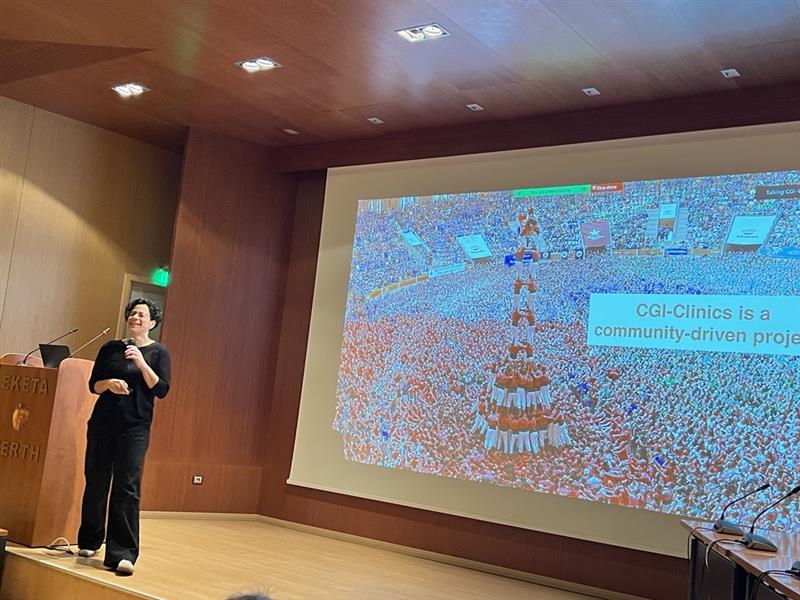
Núria López-Bigas
Project Coordinator, Núria López-Bigas, ended the meeting by thanking the consortium for their lively discussions and continued engagement in the project. The meeting offered a valuable moment to reflect on our project’s progress, made possible by the steadfast dedication of all our partners. As a truly community-driven initiative, CGI-Clinics flourishes through collaboration. We look forward to the continued advancements ahead in 2026!
About the CGI-Clinics Project
The CGI-Clinics project is a five-year EU project, and stakeholders are encouraged to follow its progress by signing up for the newsletter or following the project on social media.
