
Meet two of the experts behind the Cancer Genome Interpreter tool

Santi Demajo, Scientific Coordinator of the CGI-Clinics project, and Paula Gomis, Bioinformatician participating in the technical development of the tool, join us from IRB Barcelona to share more about their involvement in CGI-Clinics and how they anticipate the project’s progress.
Please introduce yourself and your role in the project.
We are Santi Demajo, Scientific Coordinator of the CGI-Clinics project with a special focus on the development of the new CGI tool (the work package 1 of the project), and Paula Gomis, Bioinformatician also participating in the technical development of the tool. We belong to the Barcelona Biomedical Genomics Lab from IRB Barcelona. We are in charge of the interplay with the ten different hospitals from five European countries that are the clinical partners of the CGI-Clinics project. Together, we will co-design a new CGI tool for cancer genome interpretation.
Very briefly, what is the CGI tool and how does it work?
The Cancer Genome Interpreter (CGI) is a computational tool that helps identify the genetic mutations that drive tumours and could be targeted with specific therapies. CGI uses computational methods and artificial intelligence-based algorithms, as well as knowledge collected across several databases and studies, to analyse tumour alterations and provide evidence-based annotations for the mutations.
To use CGI, oncologists, molecular biologists or cancer researchers input a list of genetic mutations from a patient’s tumour sample (that can be hundreds or even thousands) and CGI identifies which mutations are the ones driving the tumour (usually only a few of them). Moreover, CGI identifies which mutations are associated with response to certain anti-cancer drugs. The main objective of the CGI-Clinics project is to develop, during the next few years, an improved CGI tool that meets the needs of clinical practice and can be implemented in healthcare systems, thus improving personalised cancer medicine.
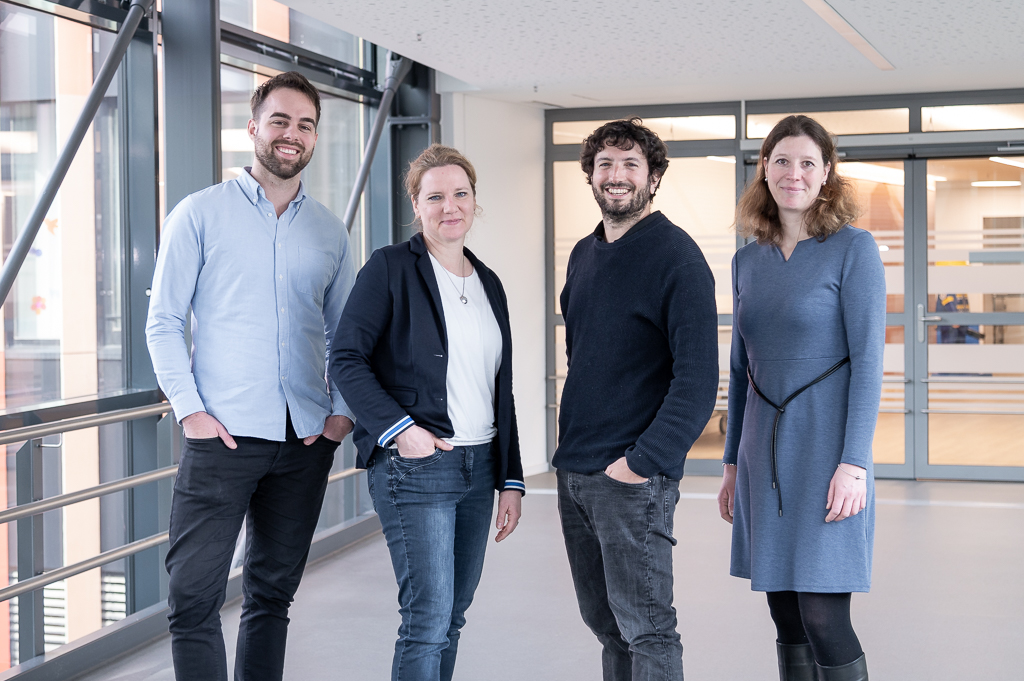
Dr. Santi Demajo (2nd from right) visiting Cologne: from left to right: Christoph Jonas, Dr. Jana Fassunke and Dr. Michaela Ihle (Molecular Pathology at the Institute for Pathology, University Hospital Cologne) – Photo: University Hospital Cologne, Michael Wodak
How do you plan to adapt the CGI tool to the needs of clinicians?
Since the beginning of the project, we are conducting interviews with all the different hospitals that are part of the CGI-Clinics consortium to understand their procedures in personalised cancer medicine, including all the steps from sequencing the DNA from the patient tumour sample to reporting the results. During these meetings, we put a special emphasis on how the interpretation of cancer mutations is performed in each centre, which is a very difficult and time-consuming part of the process that is currently performed in a non-systematic way across different hospitals.
These meetings have helped us gain insights into their work processes and requirements with the objective to build a CGI platform that is tailored to the needs of the clinical teams, making their daily work as easy as possible in the interpretation of mutations, with the final aim to benefit cancer patients. In parallel, the clinical partners are starting to test the CGI tool in development and giving us feedback and ideas on how to improve it to build a useful and user-friendly tool. This is very helpful to us to understand the real needs of personalised cancer medicine and focus our efforts on these aspects. This will be an iterative process in which the IRB team in charge of the development of the new CGI will have constant interaction with the hospitals during the next few years.
What kind of data can the CGI tool process and analyse?
Up to now, the CGI tool is able to analyse mutations obtained when sequencing tumours in hospitals. It also takes into account the tumour type of the sample, since different tumour types may have very different mutations and may be targeted with different drugs. One important added value of CGI is what we call the ‘automatic learning platform’, which are algorithms and computational methods that are able to predict the oncogenicity of mutations in a tumour type-specific manner. In the future, we plan to improve the CGI tool in a way that we can also analyse other genomic data besides mutations and also include clinical data (for example, previous treatments in the patient), to obtain more specific predictive models and achieve even more accurate interpretation.
What kind of feedback have you received from the clinical partners about the CGI tool so far?
The clinical partners are highly enthusiastic about the tool we are developing, as they believe it will improve their daily work by simplifying the interpretation process of cancer mutations. While the medical teams always make the final decision, receiving reliable and accurate information in a timely manner will speed up the process and ultimately benefit the patient. To do so, we must gain a comprehensive understanding of each hospital’s organisation, protocols, and steps involved in the interpretation of cancer mutations. This knowledge is critical to developing a tool that is easily accessible and utilised by hospitals of all types, regardless of location, size, resources or healthcare workforce.

Dr. Santi Demajo and Dr. Michaela Ihle (Molecular Pathology at the Institute for Pathology, University Hospital Cologne) – Photo: University Hospital Cologne, Michael Wodak
Are there any challenges or obstacles that the project team has faced in implementing the CGI tool at the clinical partner sites?
One of the biggest challenges we face is the diverse ways that hospitals work. Therefore, we must customise our tool to be compatible with various file formats and electronic health record systems used in different countries, each one with distinct data models. Another important challenge is ensuring that our tool meets the medical device regulations. To overcome these challenges, we count on a highly interdisciplinary team, organised in different work packages, who will address these and other future challenges in a collaborative way.
How will the project team provide ongoing support to the clinical partners on the use of the CGI tool?
During our platform-kick-off meeting three months ago, we provided an initial tutorial to show how to access and use the tool, including which file formats to introduce and how to interpret the results. However, we also offer on-demand tutorials and online personal meetings to hospitals that require additional explanations. For example, we recently did a tutorial on CGI for the team of biologists involved in cancer mutation interpretation at one of our clinical partner institutions. Moreover, we offer continuous support to our clinical partners through email or a form available on the platform. This approach enables us to assist them in using the tool and platform while also gathering valuable feedback that will be key to building the new CGI. An essential figure in this process is what we call the CGI-specialist, who is the professional from each clinical partner that is in charge of testing the CGI tool with its patient data and plays a key role as the main connection between the hospital and us.
What are the next steps for the development of the CGI tool?
The first version of CGI was developed more than five years ago. Our team has already developed a new pilot version, currently in use by clinical partners for analysing their current patients. The plan is to have, in the next few years, a more advanced platform developed together with an external software company. This new platform will contain many improvements such as a completely new interface, a new reporting system tailored to the needs of the clinical practice, options to provide statistical insights into patient data and results provided by CGI, and a functionality that enables professionals from different hospitals to interact and discuss difficult cases before making decisions. We have recently started the development of the new CGI tool, a process in which we will incorporate continous feedback from the clinical partners to ensure that the platform is optimised to the clinical context. By the end of 2024, we should be ready to start validating the new CGI tool together with the clinical partners.
About the CGI-Clinics Project
The CGI-Clinics project is a five-year EU project, and stakeholders are encouraged to follow its progress by signing up for the newsletter or following the project on social media.
